Here’s a number worth knowing: 121. That’s how many milligrams of THC lab testers found in a single hemp edible sold in Illinois — a product whose category is supposed to sit at a fraction of that per piece.
The figure comes from a state-funded Illinois study that put 527 hemp products through laboratory testing. The results were not reassuring. Twenty-six percent of the non-CBD edibles tested contained more than 10 milligrams of delta-9 THC per piece. Separate testing by University of Illinois Chicago researchers found that most of the hemp edibles and flower products they examined simply didn’t match what their packaging claimed — wrong potency, cannabinoids present that weren’t listed, listed ones that weren’t there.
The important detail: these weren’t dispensary products
Every product in those tests came from the hemp market — the gas stations, smoke shops and websites selling “hemp-derived” edibles under looser rules. That market grew up in a gap in federal law, and in most places it runs without the testing, labeling and tracking requirements that licensed cannabis operates under.
That’s the real story here. A label is only worth something if somebody checks it. In the unregulated hemp market, for a long time, nobody was checking.
How New York’s licensed market handles this
Products sold by licensed New York dispensaries go through a different pipeline:
- Testing before sale. Every batch is tested by a state-permitted laboratory for potency, pesticides, heavy metals, residual solvents and microbial contaminants before it can reach a shelf.
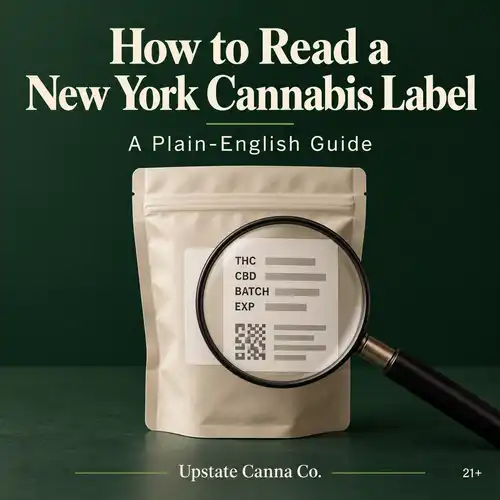
- A certificate of analysis (COA) for every batch. The lab issues a COA tied to the product’s batch or lot number. It’s the document behind the label — the label is the summary, the COA is the proof.
- Tracking from seed to sale. Licensed products move through the state’s inventory tracking system, so a package on our shelf can be traced back to the licensed grower and the tested batch it came from.
None of that exists for a bag of gummies at a gas station register.
How to check a product yourself
You don’t need a chemistry degree. Three habits cover most of it:
1. Look for the batch or lot number. It’s printed on the packaging of every licensed product. No batch number, no paper trail.
2. Ask for the COA. Scan the code on the package if there is one, or just ask us — we can pull up the lab results for anything we sell. The COA should name the testing lab, the batch, and the potency results, and they should line up with what’s printed on the label.
3. Buy from a licensed store. A New York dispensary’s license number is public. Ours is OCM-CAURD-23-000005 — Upstate Canna Co. was one of the first licensed dispensaries in the state. If a seller can’t show you a license, the label is a promise nobody verified.
The short version
The Illinois numbers aren’t a reason to worry about tested, licensed products. They’re a reminder of why the testing exists. When you shop at 1613 Union St in Schenectady, or order delivery through our site, every product on the menu has a lab report behind it — and if you ever want to see one, just ask. We’re happy to show our work.