
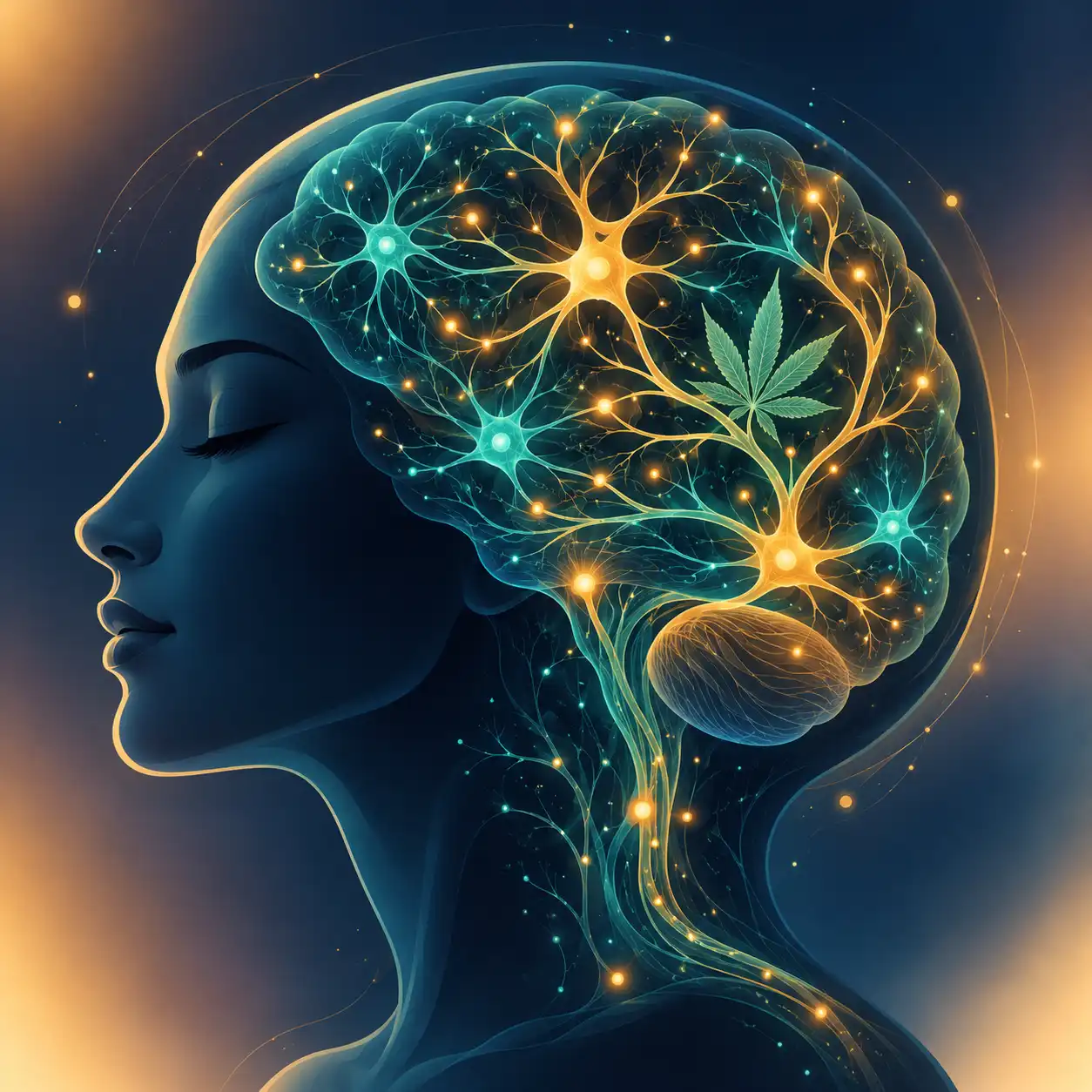
Ever had an edible kick in harder than you expected, and the relaxing evening you planned turned… anxious? You’re not alone — it’s probably the most common “too much” story in cannabis. Most people chalk it up to a bad batch or a weird mood. But a team of neuroscientists at Northwestern University just found something more specific: actual brain cells that may drive the whole thing.
The Study
Published on October 2, 2026, in the peer-reviewed journal Nature Communications, the paper is titled “Cannabinoid Modulation of Central Amygdala Population Dynamics During Threat Investigation.” The research came out of Northwestern University’s Feinberg School of Medicine, led by senior author Dr. Sachin Patel, chair of the university’s department of psychiatry and behavioral sciences, along with co-authors Farhana Yasmin, Saptarnab Naskar, Danyal Zaidi, Isaac Kandil, Michelle Kwon, and Luis E. Rosas-Vidal.
This wasn’t a survey or a review of old data. It was a controlled neuroscience experiment — the first, according to the researchers, to identify the specific neurons involved in cannabinoid-linked anxiety.
How the Experiment Worked
Here’s what they actually did, step by step:
- The drug. Researchers injected mice with varying doses of CP55940, a synthetic cannabinoid that mimics the effects of THC, the main psychoactive compound in cannabis.
- The stressor. They placed the mice in an enclosure with a petri dish of fox urine — a predator odor that naturally triggers threat responses in rodents.
- The measurement. Using implanted microscopes and a technique called in vivo calcium imaging, the team watched brain activity in real time as the mice encountered the threatening smell.
The results were striking. Mice given the cannabinoid froze more often, moved less, and spent significantly less time investigating the predator odor compared to undrugged mice — classic anxiety-like behaviors in rodent research.
The Key Finding: Somatostatin Neurons
The real breakthrough was where in the brain this was happening. The researchers traced the anxious behaviors to a small population of cells called somatostatin neurons, located in the central amygdala — the brain region that processes fear and stress.
Here’s the mechanism they uncovered: the brain normally keeps these neurons in check using GABA, an inhibitory neurotransmitter that acts as a kind of neural “brake.” The cannabinoid suppressed local GABA release — essentially loosening the brake — which allowed the somatostatin neurons to fire excessively. That overactivity, in turn, drove the anxiety-like behavior.
As Dr. Patel put it: “Higher doses of cannabinoids and environmental stress worked together to synergistically release the ‘brake’ on the central amygdala, which in turn drove excessive anxiety.”
To confirm the link wasn’t coincidental, the team ran a decisive follow-up: they genetically silenced the somatostatin neurons, then repeated the experiment. The result? The cannabinoid-treated mice no longer showed strong avoidance of the predator odor. Shut off those cells, and much of the anxious behavior disappeared.
It Was Dose-Dependent
One of the most relevant details for consumers: the effects scaled with dose. Low doses subtly increased threat avoidance without impairing the mice’s normal movement. Higher doses progressively amplified neural activity, slowed movement, and triggered intense defensive freezing.
In other words, the research supports a pattern many experienced consumers already recognize — a little and a lot can feel like two completely different experiences. This study offers an early biological explanation for why.
Stress Was the Other Half of the Equation
Just as important as dose was context. The anxiety-linked neuron activity emerged specifically when cannabinoid exposure was combined with a stressful encounter. Neither factor alone told the full story — it was the combination that released the brake.
Dr. Patel summarized the real-world implication this way: the findings “could explain why a good trip can turn bad pretty quickly if people consume too much cannabis or the situation they are in turns stressful or scary.”
Why This Matters Beyond Cannabis
Interestingly, the researchers see implications that go past cannabis itself. Because the somatostatin neurons appear to act as a final common pathway for this type of anxiety response, Patel suggests that “suppressing the activity of somatostatin neurons in the central amygdala could represent a final pathway for reducing anxiety symptoms, not just in the context of cannabis side effects.” That’s a potential direction for future anxiety research generally — though it’s very early days.
Let’s Be Honest About the Limits
Good science comes with caveats, and this study has real ones:
- It was a mouse study. Rodent brains aren’t human brains, and findings don’t always translate.
- It used a synthetic cannabinoid (CP55940), not dispensary flower, edibles, or vapes.
- It’s a single study. One paper doesn’t settle anything — it opens a door for more research.
None of this proves how any individual will respond to cannabis. But as a piece of the puzzle, it’s a meaningful one — and the mechanism it identifies lines up with what consumers have reported for years.
What Shoppers Can Take From This
We’re not doctors, and this isn’t medical advice — just practical context from emerging science:
- Give it time. Trying a new product or something stronger than usual? There’s no rush.
- Pick your setting. Comfortable and familiar tends to beat loud and chaotic.
- Check in with yourself. Already having a stressful day? That’s worth factoring in.
- Ask us. Potency questions, product differences, what to expect — our team at Upstate Canna Co. talks through this stuff every day. No question is a bad one.
The Takeaway
Science is slowly catching up to lived experience, one study at a time. For the first time, researchers have put a cellular address on the “too much” feeling — somatostatin neurons, central amygdala, brake released. We’ll keep translating the research into plain English as it comes.
Come see us at 1613 Union St in Schenectady, or browse the menu online — happy to help you shop with confidence.
For informational purposes only — not medical advice. Everyone’s different. Please enjoy responsibly, 21+ per New York State law.
References
- Yasmin F, Naskar S, Zaidi D, Kandil I, Kwon M, Rosas-Vidal LE, Patel S. Cannabinoid modulation of central amygdala population dynamics during threat investigation. Nature Communications. 2026;17(1):10127. DOI: 10.1038/s41467-026-77957-4
- Northwestern University News Center. “What happens in the brain when cannabis makes you anxious?” October 2, 2026. https://news.northwestern.edu/stories/2026/09/what-happens-in-the-brain-when-cannabis-makes-you-anxious
- Scientific American. “Why Does Weed Cause Anxiety? A New Brain Study Investigates Cannabis Paranoia.” October 7, 2026. https://www.scientificamerican.com/article/why-does-weed-cause-anxiety-a-new-brain-study-investigates-cannabis-paranoia/
- SciTechDaily. “Why Too Much Cannabis Can Flip an Anxiety Switch in the Brain.” October 2026. https://scitechdaily.com/why-too-much-cannabis-can-flip-an-anxiety-switch-in-the-brain/